
Elevate Your Website's Rankings: Schedule a Professional SEO Audit to Uncover Hidden Opportunities and Drive Growth.
✦
Transform Your Online Strategy: Book a Personalized SEO Consultation to Achieve Dominance in Global Search Results.
✦
15+ years building sustainable organic growth for B2B SaaS, e-commerce, and professional services.
Strategic SEO execution for founders who’ve been burned by agencies that optimize vanity metrics instead of outcomes.

I’m an SEO Specialist.
I provide expert SEO services that treat search as a revenue channel, not a reporting dashboard. Every engagement starts with understanding your business model, customer acquisition economics, and growth constraints—then architecting an SEO strategy that maps to those realities.
This isn’t about chasing rankings for the sake of rankings. It’s about capturing demand at the right stage of buyer intent and converting it into qualified pipeline that your sales team can close.
Whether you need a freelance SEO expert to own your entire organic channel or a professional SEO consultant to audit and optimize your current approach, I work backwards from outcomes—not forwards from tactics.
My clients don’t hire me because they want higher rankings. They hire me because paid acquisition is expensive, their CPC is climbing, and they need a channel that delivers qualified leads without burning cash.
I specialize in working with growth-stage companies and funded startups where SEO needs to perform as a measurable, accountable acquisition channel:
If you’re a small business owner looking for affordable SEO services or a startup founder evaluating whether to hire an SEO consultant or build in-house, the principles are the same: search needs to be accountable to revenue, not traffic charts.
Most SEO agencies sell the same commoditized services: technical audits, keyword research, content production, link building. The work isn’t wrong—it’s just divorced from how businesses actually grow.
They optimize for rankings because rankings are easy to report. They chase traffic because traffic looks good in dashboards. But ranking for keywords that don’t drive pipeline is waste. Traffic that doesn’t convert is noise.
The mistake isn’t tactical execution—it’s strategic misalignment. They’re solving the wrong problem. You don’t need more traffic. You need qualified visitors who match your ideal customer profile, land on the right pages, and convert at rates that justify the investment.
That requires understanding your business model, customer acquisition funnel, and unit economics before touching anything technical. Most agencies skip that step
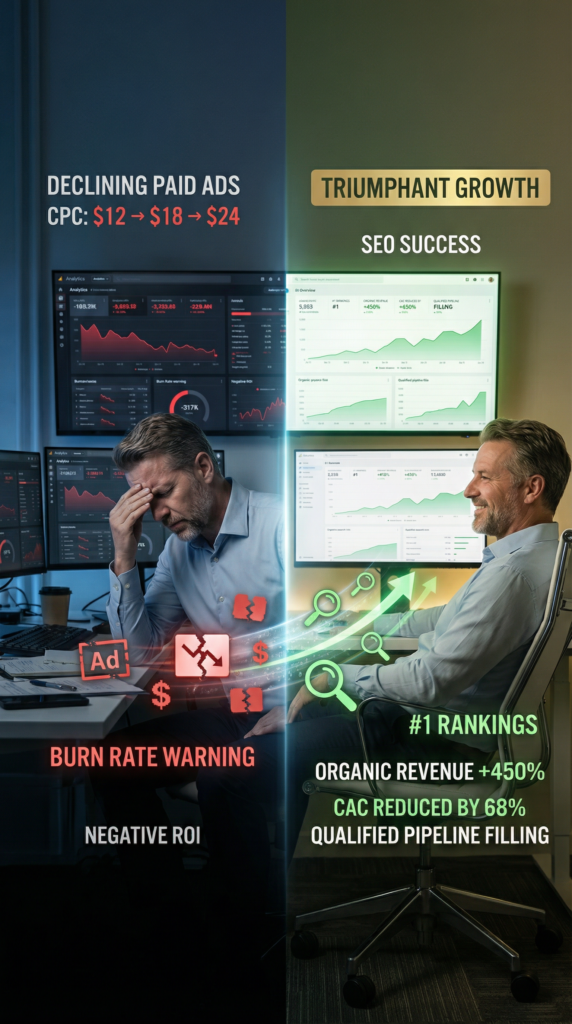
My approach is different. I start by understanding your acquisition model, customer lifetime value, and existing conversion infrastructure—then architect an SEO strategy that integrates into that system rather than operating independently.
Before I audit your site or analyze keywords, I map your business logic:
This isn’t fluffy positioning work. It’s the difference between ranking for keywords that drive qualified demos versus keywords that drive unqualified traffic that wastes your sales team’s time.
Once strategy is locked, execution becomes surgical. I don’t throw tactics at the wall. I prioritize based on ROI and effort:
For e-commerce clients, this includes platform-specific work: Shopify SEO optimization for Shopify stores, WooCommerce SEO for WordPress sites, product page architecture, category strategy, and faceted navigation handling.
For B2B SaaS, it’s bottom-of-funnel content, comparison pages, integration with product-led growth motions, and account-based content strategies that support enterprise sales.
I don’t report on rankings. I report on pipeline contribution and revenue attribution.
Every engagement includes:
If you’re used to agencies that show you traffic charts while your sales team complains about lead quality, this will feel different. I optimize for outcomes, not metrics.
Here’s what you’re actually buying when you hire me versus an SEO agency:
When you work with me, you’re not getting a junior account manager executing a playbook. You’re getting direct access to someone who’s built SEO programs from zero to millions in ARR multiple times.
No layers between strategy and execution. No handoffs where context gets lost. No game of telephone where your business constraints don’t make it to the person doing the work.
When I recommend killing a tactic or pivoting strategy, it’s because I’ve seen the data and understand the trade-offs—not because someone three levels down sent a report up the chain.
Agency retainers for professional SEO services start at $5,000-$15,000/month. Most of that pays for account management, internal meetings, project managers, and overhead. You’re subsidizing their business model.
As a freelance SEO expert, my rates are 40-60% lower—not because I cut quality, but because I don’t have agency infrastructure costs to cover. Every dollar you pay goes into strategic thinking and execution, not overhead.
If you’re evaluating affordable SEO for small business or comparing consultant vs agency pricing, the math is simple: compare deliverables per dollar invested, not total monthly spend.
Agencies optimize for client retention. They’ll spin mediocre results into wins to avoid churn. They’ll show you rankings improvements while ignoring pipeline contribution.
I optimize for referrals. My business grows when clients hit their numbers and recommend me to their networks. That means I’m incentivized to be brutally honest about what’s working and ruthless about cutting what’s not.
If a tactic isn’t delivering ROI, I’ll tell you to kill it—even if it means lower monthly revenue for me. That’s the difference between a strategic partner and a vendor.
Most agencies lock you into 6-12 month contracts. If the relationship isn’t working or your priorities shift, you’re stuck paying for services you don’t need.
I work month-to-month. You stay because the results justify the investment, not because you signed a contract. That keeps me accountable and gives you flexibility as your business evolves.
Every engagement is customized based on your business model, competitive landscape, and current SEO maturity. But here’s what’s typically in scope:
Before any tactical execution, we define:
Say Goodbye to One-Size-Fits-All SEO—Experience SEO Strategies Tailored to Your Unique Business Needs.
Technical debt kills rankings. I audit and systematically fix:
For Shopify stores, this includes platform-specific work: liquid template optimization, app conflict resolution, theme performance tuning, and URL structure optimization within Shopify’s constraints. A Shopify SEO expert who understands these platform limitations is essential.
I don’t just audit your website—we set the stage for your online success with a strategic foundation that only a top-tier SEO firm can provide.
Content isn’t blog posts for the sake of publishing. It’s strategic assets designed to capture demand at specific funnel stages and support sales conversations.
I build content systems around:
Every piece is mapped to buyer intent and built to convert, not just rank. The goal isn’t traffic—it’s qualified pipeline that sales can close.
Links still matter for rankings, but not all links are created equal. I focus on earned editorial links from relevant publications—not directory spam, not PBN garbage, not link schemes that will get you penalized.
Tactics include:
For professional services and multi-location businesses, local search is where revenue happens. Dominating Google Maps and local pack results drives qualified leads at dramatically lower cost than paid search.
As a local SEO consultant, I optimize:
For SEO for professional services like law firms, accounting practices, consulting businesses, and medical practices, local SEO often delivers the highest ROI of any marketing channel.
E-commerce SEO is a specialized discipline. Product discovery, category architecture, faceted navigation, and conversion optimization all require platform-specific knowledge.
For e-commerce clients, I focus on:
Whether you’re on Shopify, WooCommerce, Magento, or a custom platform, the goal is the same: get your products in front of buyers with purchase intent and convert them at rates that justify the investment.
B2B SEO services require understanding complex buyer journeys, long sales cycles, and multi-stakeholder decision processes. The strategy is fundamentally different from B2C or e-commerce.
For B2B SaaS and enterprise software companies, I focus on:
The goal of B2B SEO isn’t just qualified leads—it’s pipeline that sales can actually close at conversion rates that justify the investment in content and optimization.
I structure engagements to be flexible, results-focused, and aligned to how businesses actually operate.
Most clients work with me on a month-to-month retainer. This gives you flexibility to adjust scope as priorities shift without being locked into a long-term contract you can’t escape.
Typical monthly retainer includes:
If you need one-time strategic work rather than ongoing execution, I offer project-based SEO consulting:
To be direct: I’m not for everyone. Setting clear expectations upfront saves both of us time.
I’m probably not a fit if:
If you’re a founder or marketing leader who values clear thinking, direct communication, and accountability to business outcomes, we’ll work well together. If you want a yes-man who never pushes back, you’ll hate working with me.
With Elvis Ekoigiawe, You’re Not Just Getting SEO; You’re Unlocking the Key to Consistent Revenue Growth.
If you’ve read this far, you’re probably evaluating whether SEO makes sense for your business—or whether your current SEO program is actually working.

We’ll discuss your business model, current acquisition channels, traffic and conversion data, and growth constraints.

After our call, I’ll do a high-level review of your technical SEO foundations, content strategy, and competitive positioning, then send you a documented assessment.

No hard sell. No pressure. If I don’t think I can add value given your constraints, I’ll tell you honestly.
These are the questions I get most often from founders, CMOs, and marketing directors evaluating whether to hire an SEO expert or continue with their current approach.
It depends on what you’re buying and who you’re hiring. For small businesses looking for affordable SEO services, expect to pay $1,000-$2,500/month for basic optimization work—technical fixes, local SEO, basic content.
For growth-stage companies that need comprehensive SEO including strategy, content production, link building, and ongoing optimization, expect to invest $3,000-$8,000/month with a freelance SEO consultant or $5,000-$15,000/month with an agency.
The question isn’t how much SEO costs—it’s whether SEO drives qualified pipeline at a lower customer acquisition cost than your paid channels. If you’re paying $5,000/month for SEO and it drives $50,000 in revenue, that’s a bargain. If you’re paying $5,000/month and getting vanity metrics with no pipeline contribution, you’re overpaying.
An SEO consultant is someone who advises businesses on how to improve their search engine visibility and organic traffic. Unlike SEO agencies that provide full-service execution with teams of specialists, a consultant typically focuses on strategy, audits, and high-level recommendations.
Some SEO consultants (like me) also handle tactical execution—building content, fixing technical issues, managing link acquisition—but the defining characteristic is strategic thinking rather than just tactical implementation.
The advantage of working with an independent SEO expert versus an agency is direct access to senior-level strategic thinking without paying for account managers, project managers, and agency overhead.
Yes—if you’re in a market where people actively search for your product or service. SEO for small businesses works exceptionally well when you can dominate local search or rank for niche keywords with clear buyer intent.
The mistake most small businesses make is trying to compete nationally for generic, highly competitive keywords instead of owning their local market or targeting long-tail keywords where they can actually win.
For local service businesses—plumbers, dentists, lawyers, accountants, contractors—local SEO is often the highest-ROI marketing channel available because the leads are high-intent and the cost per acquisition is dramatically lower than paid advertising.
Start by asking for case studies and references from previous clients. A good SEO consultant should be able to show you concrete, measurable results—traffic growth percentages, ranking improvements for specific keywords, or better yet, revenue attribution and pipeline contribution.
Ask about their process: do they start with comprehensive strategy or jump straight into tactics? Do they focus on technical SEO, content, links, or all three? And most importantly, ask how they measure success. If they talk about rankings and traffic instead of business outcomes and ROI, that’s a red flag.
The best way to evaluate whether to hire an SEO specialist is to have a strategy conversation first—see if they ask good questions about your business model, understand your constraints, and can articulate a clear approach.
Professional SEO services typically include technical SEO audits and ongoing fixes, keyword research and strategic planning, content creation and optimization, link building and digital PR outreach, performance tracking and reporting, and ongoing strategic consultation.
The specific mix depends on your business model and needs. For e-commerce, you’ll need product page optimization, category architecture, and structured data.
For SaaS and B2B companies, you’ll need bottom-of-funnel content, comparison pages, and integration pages. For local businesses, you’ll need Google Business Profile optimization, local citations, and review management.
For any business model, you need technical foundation work, content that captures demand, and links that build authority.
Yes, but it takes time and consistent execution. SEO works when you build a sustainable competitive advantage—better content, better site experience, better domain authority—and compound it over months and years.
You won’t see meaningful results in 30 days. You’ll start seeing traction in 3-6 months as technical issues get fixed and initial content starts ranking.
You’ll see significant results in 6-12 months as your content library grows, and link authority builds. If someone promises faster results, they’re either lying or using black-hat tactics that will eventually get you penalized.
SEO is not magic—it’s strategic, patient, consistent execution that compounds over time.
SEO specialists charge anywhere from $100-$300/hour depending on experience, expertise, and market. For project-based work, expect to pay $2,500-$10,000 for a comprehensive audit and strategy. For ongoing monthly retainers, freelance SEO specialists typically charge $2,000-$8,000/month depending on scope.
Agencies charge significantly more—$5,000-$15,000/month or higher—because you’re paying for overhead, not just expertise. The key is comparing value delivered per dollar invested, not just comparing total monthly costs.
A great SEO expert delivering measurable results at $5,000/month is dramatically cheaper than a mediocre agency burning $10,000/month on tactics that don’t move the needle.
SEO is expensive because it’s labor-intensive and requires deep, specialized expertise across multiple disciplines—technical SEO, content strategy, link building, analytics, conversion optimization.
You’re not just paying for someone to optimize meta tags and write blog posts. You’re paying for strategic thinking, technical problem-solving, content production, outreach and relationship building, and ongoing performance optimization.
Good SEO requires significant time investment: researching keywords, auditing technical issues, creating high-quality content, earning editorial links, analyzing performance data, and continuously iterating. If someone is charging $500/month for comprehensive SEO, they’re either not doing the work or they’re cutting corners that will hurt you long-term.
That said, agencies often overcharge because you’re subsidizing their business model—overhead, account managers, internal meetings, profit margins. Hiring a freelance SEO expert is typically 40-60% cheaper than agency pricing for equivalent quality work.
SEO services are worth it if they generate positive ROI by driving qualified pipeline at customer acquisition costs that beat your paid channels. If you’re paying $5,000/month for SEO and it drives $50,000 in revenue at acceptable conversion rates, it’s absolutely worth it.
If you’re paying $5,000/month and getting nothing but vanity metrics—traffic charts, ranking reports—with no actual pipeline contribution, it’s a waste of money. The mistake most companies make is judging SEO services on intermediate metrics like rankings and traffic instead of business outcomes.
Before hiring an SEO consultant, get crystal clear on how you’ll measure success and what customer acquisition cost threshold makes SEO profitable for your business model.
B2B SEO is search engine optimization specifically for companies selling to other businesses rather than consumers. The strategy is fundamentally different because B2B buyers have longer sales cycles, higher deal values, more complex decision-making processes involving multiple stakeholders, and they conduct extensive research before purchasing.
B2B SEO services focus on capturing demand from decision-makers at different stages of the buying journey: awareness stage (educational content explaining problems and frameworks), consideration stage (comparison pages and alternative pages intercepting evaluators), and decision stage (product pages, case studies, ROI calculators).
The goal isn’t just driving traffic—it’s generating qualified pipeline that sales can convert into closed deals.
Shopify is decent for SEO out of the box, but it has platform-specific limitations that require workarounds. The biggest issues are: limited URL structure customization (you’re stuck with /collections/ and /products/ in URLs), slow page speed with poorly optimized themes and excessive app installations, potential duplicate content issues from product variants and collections, and limited control over structured data implementation.
That said, Shopify SEO optimization is entirely possible—I’ve worked with multiple Shopify stores that rank competitively and drive significant organic revenue. The key is choosing a fast, well-coded theme, minimizing app bloat, optimizing product pages with target keywords and compelling content, building a logical collection hierarchy with solid internal linking, and implementing proper technical SEO.
If you need expert Shopify SEO services, working with a Shopify SEO expert who deeply understands the platform’s constraints and workarounds is essential.
For small businesses, affordable SEO services typically range from $1,000-$2,500/month depending on scope and complexity. At the lower end ($1,000-$1,500/month), you’re typically getting basic optimization work: meta tag optimization, local citations, Google Business Profile setup and management, basic technical fixes.
At the higher end ($2,000-$2,500/month), you’re getting more strategic work: comprehensive keyword research, regular content production, active link building, ongoing technical maintenance.
If you’re a small business owner trying to decide whether SEO is worth the investment, focus on local search first. Dominating local keywords and Google Maps can drive consistent, qualified leads without competing against national brands with massive budgets.
An SEO consultant is typically a solo practitioner or very small team focused on strategy and hands-on execution. An SEO agency is a larger organization with multiple clients, dedicated account managers, and specialized team members for different SEO disciplines.
The main differences: consultants offer direct access to senior-level strategic thinking at 40-60% lower costs, while agencies offer more bandwidth and specialized resources but with significantly higher overhead costs. If you’re a founder or marketing leader who wants a strategic partnership with direct access to expertise, a freelance SEO expert is usually the better fit.
If you need a full team of specialists working simultaneously on different aspects of SEO, an agency might make sense—but expect to pay 2-3x more for equivalent quality of strategic thinking.
Most SEO consultants charge using one of three models: hourly rates ($100-$300/hour depending on expertise and market), project-based fees for one-time work ($2,500-$10,000 for audits and strategy), or monthly retainers for ongoing work ($2,000-$8,000/month for comprehensive SEO services).
Monthly retainers are the most common model because SEO is fundamentally a continuous process—you can’t optimize once and walk away. The best SEO consultants work month-to-month without long-term contracts, which keeps them accountable and gives you flexibility as priorities shift.
Avoid anyone requiring 6-12 month contracts upfront—that’s an agency trying to lock you in regardless of results.
Yes, absolutely. Shopify SEO is entirely possible, though it requires platform-specific knowledge and workarounds for limitations.
The Key Challenges are: limited URL customization (you can’t remove /collections/ and /products/ from URLs), potential duplicate content from product variants, page speed issues with poorly coded themes, and constraints on technical implementation.
The Solutions: optimize product titles and descriptions with target keywords, build a logical collection hierarchy with strong internal linking, use canonical tags properly to avoid duplicate content penalties, compress images aggressively and minimize app usage to improve page speed, implement structured data for product rich results, and build quality backlinks to overcome any technical limitations.
If you’re serious about ranking your Shopify store competitively, hiring a Shopify SEO expert who deeply understands these platforms constraints will save you months of trial and error.
For small businesses, SEO levels the playing field against larger competitors. You can’t outspend big companies on paid advertising, but you can outrank them with better content, better local optimization, and better site experience.
SEO for professional services (lawyers, accountants, consultants, contractors) is especially valuable because high-intent searches convert directly into consultation requests and new clients.
The key is focusing on what you can realistically win:
Local SEO in particular offers exceptional ROI for small businesses because the leads are high-intent, geographically qualified, and cost dramatically less than paid search or other acquisition channels.
SEO specialists audit websites to identify technical issues and optimization opportunities, research keywords to target based on search volume and business value, optimize existing content and create new content to capture target keywords, build high-quality backlinks to increase domain authority, track performance metrics to measure ROI and identify optimization opportunities, and provide strategic recommendations for continuous improvement.
But the best SEO specialists don’t just execute tactics—they think strategically about how search fits into your broader acquisition strategy. They ask questions about customer acquisition cost, conversion rates, customer lifetime value, and sales cycle length.
Then they build an SEO program that maps directly to those business realities rather than just chasing rankings for the sake of rankings.
Look for proof of results, not just certifications or credentials. Ask for case studies with specific, measurable outcomes: traffic growth percentages, ranking improvements for competitive keywords, revenue attribution, pipeline contribution.
Ask about their process—do they start with comprehensive business and competitive analysis before jumping into tactics?
Do they think in terms of business outcomes or just SEO metrics?
Check if they understand your specific business model (B2B SaaS requires different strategy than e-commerce, which requires different strategy than local services). And evaluate their communication style carefully.
The best SEO experts can explain complex technical concepts in plain language because they deeply understand what they’re doing. If someone hides behind jargon or can’t clearly articulate their approach, that’s a red flag.
The best SEO company for small businesses is one that specializes in your specific industry vertical and has proven experience with companies your size.
Large agencies often ignore small business clients because the profit margins are lower—you’ll get junior resources executing playbooks rather than strategic thinking. Look for boutique agencies or freelance SEO consultants who focus specifically on small business SEO services.
Check their case studies and testimonials carefully, ask for references you can actually call, and make sure they understand local search if that’s relevant to your business model. Be extremely wary of anyone promising guaranteed rankings or instant results—those are red flags indicating either incompetence or black-hat tactics that will eventually get you penalized by Google.
SEO is an investment that builds compounding returns over time, not an ongoing expense that disappears when you stop paying. If you frame it purely as a cost, it seems expensive. If you frame it as an acquisition channel with superior unit economics compared to paid advertising, it’s one of the most cost-effective growth levers available.
The real question is:
What’s the alternative?
Paid ads require continuous spend with zero residual value when you stop. SEO builds an asset—rankings, content, authority—that continues generating returns long after you’ve made the investment.
That said, cheap SEO is genuinely expensive in the long run.
Low-quality links, thin content, and black-hat tactics will get you penalized, costing far more to fix than if you’d invested in quality work from the beginning.
You should pay whatever delivers positive ROI based on your unit economics. If affordable SEO services at $1,500/month drive qualified leads that convert into $15,000 in revenue, that’s an excellent investment. If expensive services at $10,000/month drive traffic that doesn’t convert, that’s a complete waste.
The right price depends on your market competitiveness, current site health, how much content and link building work is required, and your internal capacity to support SEO execution. For small businesses with straightforward sites and local focus, $1,000-$3,000/month is reasonable. For competitive national markets with complex sites, expect to invest $5,000-$10,000/month.
The key is aligning cost with expected business outcomes and measuring actual pipeline contribution, not just traffic growth or ranking improvements.
An e-commerce SEO specialist focuses specifically on optimizing online stores for search visibility and conversion.
This requires unique expertise:
E-commerce SEO is fundamentally different from service business SEO because you’re optimizing for transactional intent rather than informational intent. An ecommerce SEO specialist should understand merchandising, category strategy, seasonal trends, competitive product positioning, and conversion optimization as deeply as they understand technical SEO and link building.
SEO makes money by driving qualified organic traffic that converts into customers at acquisition costs lower than your paid channels.
When someone searches for your product or service, your site ranks prominently in results, they click through, and they convert—that’s how SEO generates revenue. The economic logic is straightforward: if SEO-driven customers have customer acquisition costs 50-70% lower than paid search customers and equal or better lifetime value, SEO is massively profitable.
The ROI calculation is simple: organic traffic volume multiplied by conversion rate multiplied by average order value or customer lifetime value, minus the cost of SEO services and content production. If that number is positive and beats your alternative acquisition channels, SEO is making you money.
Yes, SEO works exceptionally well for small businesses—especially those serving local markets or operating in niche industries. The key is focusing on battles you can actually win.
Don’t try to compete nationally for generic, highly competitive keywords. Instead, dominate local search through Google Maps and local pack results, rank for niche long-tail keywords where larger competitors don’t bother competing, and build authority in your specific geographic or industry vertical.
For professional services like law firms, accounting practices, dental offices, and contractors, local SEO is often the single highest-ROI marketing channel available.
The investment required is relatively affordable compared to paid advertising, and the results compound over time rather than disappearing when you stop spending.
Worldwide SEO services (also called international SEO services) help businesses rank in multiple countries, languages, and search engines beyond just Google in English-speaking markets.
This requires specialized expertise:
International SEO is significantly more complex than single-market SEO because search behavior, competitive landscapes, and ranking factors vary dramatically by region. If you’re expanding globally, working with an international SEO consultant who understands cross-border SEO strategy is essential.
A local SEO consultant specializes in helping businesses rank in local search results and Google Maps for location-specific queries.
This includes:
Local SEO is critical for businesses with physical locations or defined service areas: restaurants, retail stores, professional services, contractors, medical practices, and multi-location businesses. A skilled local SEO expert understands Google Local Pack ranking factors and how to systematically outrank competitors in your geographic market.
Yes—if you commit to doing it properly over a sustained timeframe. SEO is worth it when you invest enough time to see results (6-12 months minimum), target keywords with genuine commercial intent rather than just high search volume, build quality content and legitimate links rather than cutting corners, and measure success by business outcomes (revenue, pipeline, qualified leads) rather than vanity metrics (traffic, rankings).
The companies that succeed with SEO treat it as a strategic growth channel that requires patient, consistent investment. They understand that rankings compound over time, content assets appreciate in value, and organic traffic has superior unit economics compared to paid acquisition.
SEO is not worth it if you expect instant results, aren’t willing to invest in quality content and links, or judge success purely by traffic volume rather than business impact.
B2B SEO services are designed specifically for companies selling to other businesses rather than consumers. The strategy fundamentally differs because B2B buyers conduct extensive research over weeks or months, involve multiple stakeholders in purchase decisions, prioritize ROI and business value over emotional factors, and often have long, complex sales cycles.
B2B SEO services focus on:
A B2B SEO agency or consultant should deeply understand your sales cycle and build content that directly supports enterprise selling, not just generate traffic.
Start by clearly defining what you need: strategic consulting, tactical execution, or both.
Then evaluate candidates based on:
Ask detailed questions about their process: do they start with strategy or jump into tactics? Do they focus on quick wins or sustainable long-term growth? How do they prioritize when resources are constrained? How do they measure and report on success? The best SEO specialists act as strategic partners who challenge assumptions and push back when strategies don’t make business sense.
SEO professional services refer to high-quality, strategic SEO work delivered by experienced practitioners rather than commodity SEO from low-cost providers or automated tools.
This includes:
The term professional signals that you’re getting customized strategies built for your specific business model, competitive landscape, and growth goals—not off-the-shelf SEO packages.
When evaluating SEO professional services, look for consultants or agencies with deep expertise, proven track records with case studies, transparent processes, and clear accountability to business outcomes.
An SEO specialist job description typically includes:
The best SEO specialists combine technical expertise, strategic thinking, analytical skills, and excellent communication. They understand how SEO integrates with broader marketing and business goals rather than operating in isolation.
For hiring purposes, prioritize proven results over certifications, strategic thinking over tactical execution, and business acumen over pure technical knowledge.
